I expected him to come late. Oh, third baby, third babies are tricky, you never know, everyone said. But Mum didn’t book her ticket to arrive until I was 40+2. I went on maternity leave at 37 weeks, and I wasn’t ready for him at that point anyway – there was so much to do! I tidied up the spare room so Mum would have somewhere to sleep, I cleaned up my own room and put the bassinet together. I spent most of my second week painting Felix and Antonia’s room a pearly sky-blue as the walls in there were charcoal grey which was too gloomy. I knitted his baby blanket. I walked most nights past fields and trees and listened to the birds.
Nevertheless, as the due date sails past, you can’t help but get edgy. I had hoped for a quiet week with Mum before he arrived, and I got it, more or less, though two public holidays at the end of the week impacted the level of ‘quiet’. On Friday, when I was 41+1, we all went down to the seaside town of Stromstad in the morning, and had coffee and cake, and walked around the harbour, looking at the boats in the sunshine. It was one of those magic little strolls where both kids were engaged, and they chatted about which boats they wished they had. Antonia said she was going to build a girl boat, only for girls, and she would be the captain. Felix wanted to sit on the sunny bench looking out over the harbour, and we cuddled.
I was tired and uncomfortable. We waited and waited. Finally, on Monday May 29th, at 41+4, it was time for my overdue check-up at the hospital. The CTG was fine. The ultrasound was fine. The doctor examined me, giving me a ‘stretch and sweep’ in the process. It was profoundly uncomfortable. I think with Antonia I’d had the ‘stretch’ but not the ‘sweep’. She told me I was only 2cm dilated. She said it might happen on its own, but it might not happen in time, and booked me in to begin an induction on Wednesday. They would start with a balloon, she said, and probably send me home, and I’d have to come back in for the gel on Thursday morning. I was a little disappointed. At my check with Antonia I’d been four centimetres, and the doctor had been confident that it would start soon, which it did. I had hoped to avoid induction. Partly because the thought of it was a little scary – deliberately beginning all that pain, but mostly because I wanted to experience again that magical moment, the gift, the surprise, the wondering – oh, is it now?
After my overdue check with Antonia, I knew she would come soon. This time I wasn’t sure. After our hospital visit, we called in for lunch with my dear friend Margrethe and her baby boy Alfred. She had baked ‘come out baby’ brownies, as we traditionally eat cake together the day before our babies are born. They were delicious. I had two.
At home I lay down for a bit before the kids came home, and then Antonia came to find me and bounced all over me. In the evening I felt tired and a bit crampy, but this was not entirely new, and I didn’t feel any clear signs. I read Antonia her books and watched her fall asleep. I felt too listless to knit. I rallied myself to go walking again with Mum, past the fields, through the forest, but we didn’t do the whole route. Like every night, the grass was visibly longer, and new flowers had uncurled.
As I went to bed myself, earlier than usual, I wondered if things would start happening, but I was just not sure. Everything seemed to settle, and I went to sleep. I woke a couple of times, as you do when you are pregnant, and there was nothing, so I resolved myself to waking in my own bed in the morning, once again. And then, at quarter to two, the strangest thing happened. I must have been only half asleep, because I felt it so clearly, A very sharp kick, and then a very clear leak. I started awake, shocked. In my last two labours, my waters hadn’t broken till the baby was nearly crowning. This was different. For a moment I contemplated what to do – I was alone, as Michael was sleeping upstairs. Then I lunged for the bathroom, dripping as I went, grabbed two towels and sat down on the floor against the bed. Oh, I thought. Oh.
It felt like a very singular situation. I sent a message to my facebook group of women having babies in May. Some said ring the hospital. Some said wait. I still felt quite sleepy, so I clambered back into bed, clutching my towels. There was a gentle contraction. And another. I decided to time them before I rang the hospital. They weren’t that frequent – six to ten minutes apart, but I remembered how quickly things had happened last time, and the hospital is about forty minutes away, so I rang. By now it was about 2.30. They agreed I should come in, so I went upstairs to wake Michael. He went to make a cup of tea. We’ll have to leave quite soon, I said. After a brief flurry of packing the car, a third of a cup of tea each, and five long minutes to locate Michael’s glasses, we were off.
It was night time, but it wasn’t quite dark. The contractions were not bad yet, and they were well spaced. When they came I tapped at my thighs, as I had when Antonia was born, and they were fine. ‘We’ve got this’, I said to Michael, trying to convince myself more than anything. ‘Yes,’ he said, ‘you’ll be fine. You’ll be great.’ I looked out at the shining string of streetlights on the freeway through the haze of the rain.
The hospital carpark was nearly deserted. As Michael went to get the parking ticket, I stood and watched the tiny raindrops glinting and floating in the beams of the car’s headlights. I walked back and forth for a bit. The air smelled so good. We could hear birds singing all around. I would have quite happily stayed there for an hour or so, I think, listening to the birds and walking in the quiet rain, but I took a deep breath, and we went inside.
Because we had left early, this was so different to Antonia’s birth, when I could barely walk and certainly couldn’t speak by the time we got there. We wandered in and chatted to the midwives as they got the room set up for us. It had an antiseptic smell after the lovely rain outside, but I resigned myself to it and felt grateful to be in a place where I was safe. I felt slightly silly to have come so early but the midwives assured me that it was okay to spend a few hours in hospital before the baby was born. They hooked up the CTG and I lay on the bed for half an hour while they checked the baby was ok. When the contractions came I tapped the sheets to distract myself. They were still quite mild. After that they checked my dilation. 4 cm! This cheered me considerably. They recommended I have an enema though, so I lay on my side for another ten minutes while we waited for it to work. I scratched at the edge of the sheets to get through the contractions, breathing through them, focussing on the little stripes on the light on the ceiling. One of my midwives massaged my lower back and it felt blissful.
After that the contractions sped up. But it wasn’t like the other births. Felix’s birth had been a marathon, and Antonia’s had been filled with energy and fierceness. This felt – quiet in comparison, almost gentle, the contractions imperceptibly becoming more formidable – sliding along rather than accosting me. I sat on the fit-ball for a little while and felt myself beginning to vocalise very gently, while I puffed out air through my cheeks. And then I made a dive for the bed, and lay on my side. I was tired. I didn’t want to stand. I was cold too, and the midwives wrapped warm towels around my shoulders. I looked up for the light again but sadly had taken off my glasses at some point so couldn’t focus on it any more. I felt myself getting a bit louder. And then I felt sick. Michael had to help me explain to the midwives that I needed a sick bag – there was some language confusion. Being sick in the middle of a contraction is not the most pleasant thing. After that there were a couple of strong contractions that I Aaaahed and yelled my way through. I was able to remind myself that it wouldn’t be long… And then suddenly they were telling me to push.
I was shocked. I didn’t feel quite ready. Push, they kept saying, you need to push NOW. Later they told me his heart-rate had dropped to 60, hence the rush, but they didn’t tell me at the time. With Antonia they had told me to wait a bit, and she had practically pushed herself out, so I was surprised. ‘I can’t do it!’ I said over and over again. ‘Yes you can! You need to! When you have a contraction, PUSH!’ Michael coached me too. ‘Come ON!’ he said. They flipped me back on to my back. Okay, I thought, if you insist. I could feel a very sharp ring of pain that did not want me to push toward it but I realised there was no way around it. I pushed as hard and as many times as I could through a couple of contractions. Pushing a baby out is strange as it feels so ineffectual. I was concentrating intently but they interrupted me – ‘breathe!’ they reminded. Hah, I thought, I don’t really have time for that, but obliged and took a little breath. Michael said later I was getting a little blue in the face. And then his head came out, and then the rest of him, and he was here.
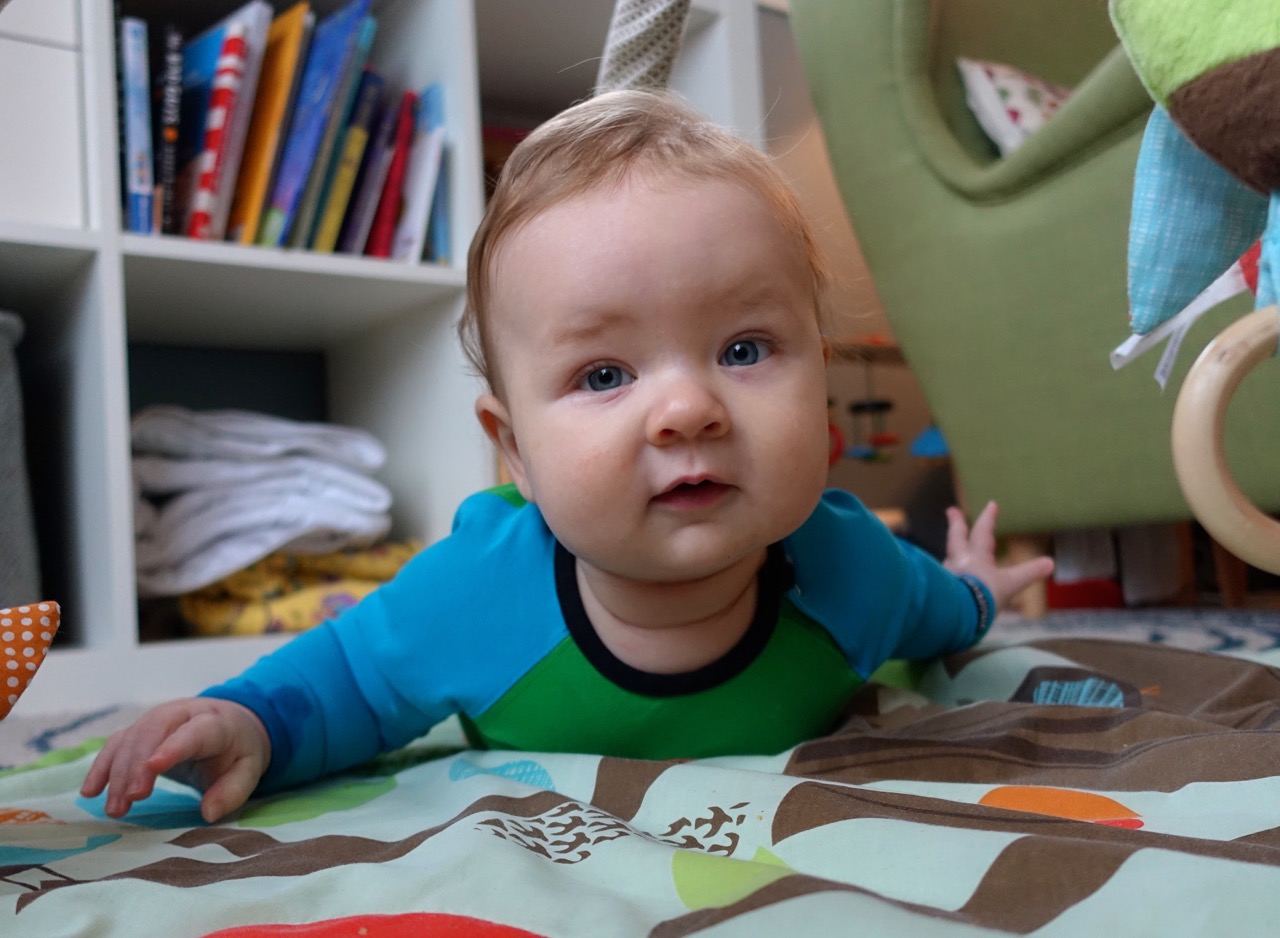
5.58 am. We’d been at the hospital for a couple of hours, and the entire labour had lasted for four. Julius flopped on my belly and I stroked him while the midwives wiped him and me down as he pooed all over my belly. He made some noises but wasn’t really crying. I couldn’t tear my eyes away from his little face. He looked like Felix, he looked like Antonia. After a while they let Michael cut the cord. I cuddled my baby while the midwives stitched up a little tear – it turned out it wasn’t a bad one, but I wondered, as they seemed to take forever. I sang a silly nursery rhyme – one of Antonia’s favourites, about sleeping, hopping bunnies – to distract myself from the stinging. Then they helped Julius latch on, and he had a good drink, and it felt amazing. They moved us to another room, and I held and held him. His movements were so familiar to me from the months he had spent inside me – the shifting of his back, his long feet, his sharp little heels. He was here. He was here. He was here.


Felix’s birth story is here, and Antonia’s is here.























 northern lights